

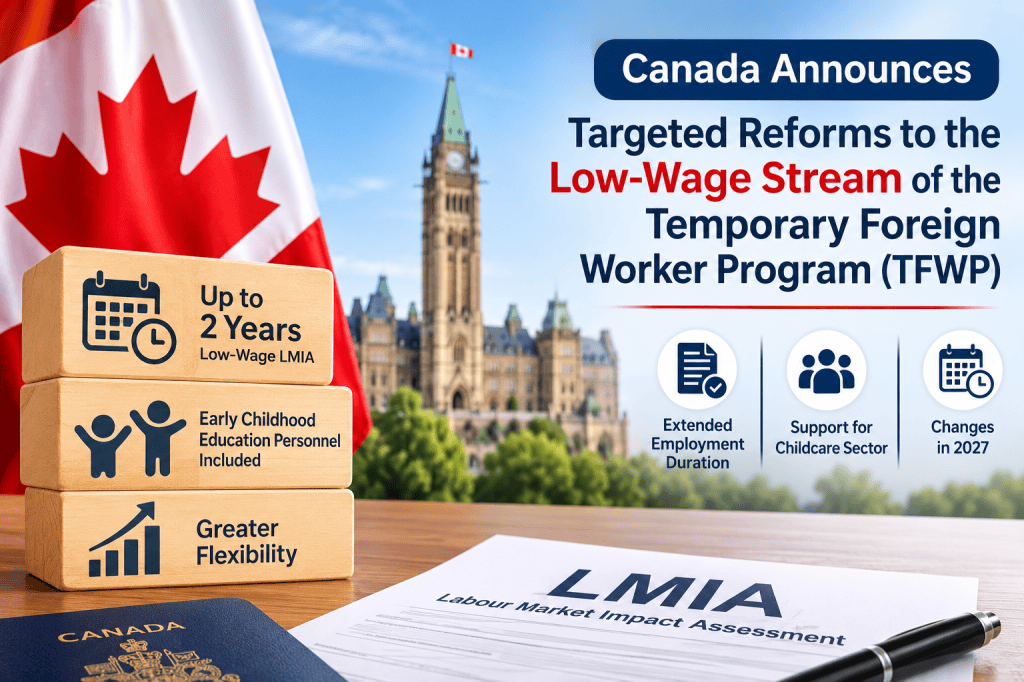
November 6, 2026 | Employment and Social Development Canada (ESDC)
Employment and Social Development Canada (ESDC) has announced targeted reforms to the Temporary Foreign Worker Program (TFWP), including significant adjustments to its low-wage stream.
The changes are intended to address labour market needs, provide greater predictability for employers, and support sectors facing persistent recruitment challenges.
1. Changes effective November 6, 2026
Two important measures took effect immediately:
1. Extension of the maximum employment duration under low-wage LMIAs
The maximum employment duration that may be approved under a new Labour Market Impact Assessment (LMIA) application in the low-wage stream has increased from one year to two years.
This is a significant development for employers who rely on temporary foreign workers, as well as workers seeking greater employment stability. Previously, employers and workers often had to go through the LMIA and work permit renewal process after only one year.
2. Exemption for early childhood education personnel
Early childhood education personnel have been added to the exceptions to the processing restrictions applicable to low-wage LMIA applications in census metropolitan areas (CMAs) with an unemployment rate of 6% or higher.
This measure is particularly relevant to the childcare sector, where employers continue to face recruitment and staffing challenges. Eligible positions, including early childhood educators and assistants, will benefit from this exception.
2. Why are these changes important?
These adjustments represent a notable easing of certain restrictions introduced on September 26, 2024, when the federal government tightened access to the low-wage stream of the TFWP.
The extension of the employment duration to two years offers employers greater workforce planning stability and reduces the frequency of renewal procedures. For foreign workers, it may mean a longer period of authorized employment without having to repeat the entire LMIA and work permit application process after just one year.
The exemption for early childhood education personnel also recognizes the particular recruitment challenges faced by the childcare sector, where wages often fall below the threshold separating the low-wage and high-wage streams.
3. Understanding the different validity periods
It is important to distinguish between the validity of a positive LMIA, the employment duration approved under the LMIA, and the validity of the resulting work permit.
| Element | Applicable duration | Explanation |
|---|---|---|
| LMIA validity period | Generally 6 months | The period within which the foreign worker must submit their work permit application following a positive LMIA. |
| Approved employment duration under a low-wage LMIA | Up to 2 years | The maximum employment period that may be approved under the revised low-wage stream rules. |
| Work permit validity | Up to 2 years | Determined by IRCC, taking into account the approved employment period, passport validity, and other applicable requirements. |
Important: A two-year LMIA employment duration does not automatically guarantee a two-year work permit. IRCC remains responsible for assessing and determining the validity of the work permit.
4. Additional changes coming March 1, 2027
Further adjustments are scheduled to take effect on March 1, 2027, subject to the participation of provincial and territorial governments.
The announced measures include:
- Greater flexibility between metropolitan and rural areas: Adjustments to low-wage TFWP restrictions to better account for differences in local labour market conditions.
- Increased workforce cap in designated communities: In communities designated by provincial and territorial authorities, eligible employers will be able to increase the proportion of temporary foreign workers employed at certain establishments from 10% to 15%.
- Continued flexibility for priority sectors: The existing 20% cap will remain available to eligible employers in designated priority sectors.
5. What should employers and foreign workers take away from this announcement?
These reforms are an important development for employers who depend on the TFWP to address labour shortages, particularly in sectors where recruiting locally remains challenging.
However, the changes do not eliminate the existing requirements and restrictions governing the TFWP. Employers must continue to comply with applicable LMIA requirements, wage thresholds, workforce caps, and other program conditions.
Foreign workers should also remember that an approved LMIA and a work permit are two separate stages of the process, each subject to its own requirements and assessment.
Official Government Announcement
For complete details, eligibility considerations, and the government’s explanation of these reforms, consult ESDC’s official announcement here.
Immigration programs and policies are subject to change. Employers and foreign workers should assess their individual circumstances before making decisions based on these measures.

